Cost Accounting - Classification of Cost
Costs can be classified based on the following attributes:
A cost sheet is prepared to know the outcome and breakup of costs for a particular accounting period. Columnar form is most popular. Although cost sheets are prepared as per the requirements of the management, the information to be incorporated in a cost sheet should comprise of cost per unit and the total cost for the current period along with the cost per unit and the total cost of preceding period. Data of financial statement is used for preparation of cost sheet. Therefore, reconciliation of cost sheet and financial statement should be done on a regular interval.
Financial accounting is based on actual past and cost accounting is based on planning and controlling. Preparation of budget is a part of planning and controlling relates to putting a check on the actual function of planning. Comparison of budgeted with actual performance provide the management an idea to eliminate weak performances.
Reduction of cost should be in the following manner:
Material Cost
Design of product should encourage to find out possibility of cheaper raw material as a substitute, maximum production, less quantity etc.
Labor Cost
Design of product may reduce time of operation, cost of after-sale service, minimum tolerance, etc.
Organization
Employees should be encouraged for cost reduction scheme. There should be no scope for doubts and frictions; there should be no communication gap between any department or any level of management; and there must be proper delegation of responsibilities with defined area of functions of an organization.
Factory Layout and Equipment
There should be a proper study about unused utilization of material, manpower and machines, maximum utilization of all above may reduce cost of any product effectively.
Administration
An organization should make efforts to reduce the cost of administrative expenses, as there is ample scope to do so. A company may evaluate and reduce the cost of following expenses, but not the cost of efficiency:
Following areas can be covered under the cost reduction program:
After performing this analysis, the organization can focus on the
customers who are covering most of the sales volume. According to it,
the cost reduction program may be run successfully in the area of
category B and C.
By Nature
In this type, material, labor and overheads are three costs, which can be further sub-divided into raw materials, consumables, packing materials, and spare parts etc.By Degree of Traceability of the Product
Direct and indirect expenses are main types of costs come under it. Direct expenses may directly attributable to a particular product. Leather in shoe manufacturing is a direct expenses and salaries, rent of building etc. come under indirect expenses.By Controllability
In this classification, two types of costs fall:- Controllable - These are controlled by management like material labour and direct expenses.
- Uncontrollable - They are not influenced by management or any group of people. They include rent of a building, salaries, and other indirect expenses.
By Relationship with Accounting Period
Classifications are measured by the period of use and benefit. The capital expenditure and revenue expenditure are classified under it. Revenue expenses relate to current accounting period. Capital expenditures are the benefits beyond accounting period. Fixed assets come under category of capital expenditure and maintenance of assets comes under revenue expenditure category.By Association with the Product
There are two categories under this classification:- Product cost - Product cost is identifiable in any product. It includes direct material, direct labor and direct overheads. Up to sale, these products are shown and valued as inventory and they form a part of balance sheet. Any profitability is reflected only when these products are sold. The Costs of these products are transferred to costs of goods sold account.
- Time/Period base cost - Selling expenditure and Administrative expenditure, both are time or period based expenditures. For example, rent of a building, salaries to employees are related to period only. Profitability and costs are depends on both, product cost and time/period cost.
By Functions
Under this category, the cost is divided by its function as follows:- Production Cost - It represents the total manufacturing or production cost.
- Commercial cost - It includes operational expenses of the business and may be sub-divided into administration cost, and selling and distribution cost.
By Change in Activity or Volume
Under this category, the cost is divided as fixed, variable, and semi-variable costs:- Fixed cost - It mainly relates to time or period. It remains unchanged irrespective of volume of production like factory rent, insurance, etc. The cost per unit fluctuates according to the production. The cost per unit decreases if production increases and cost per unit increases if the production decreases. That is, the cost per unit is inversely proportional to the production. For example, if the factory rent is Rs 25,000 per month and the number of units produced in that month is 25,000, then the cost of rent per unit will be Rs 1 per unit. In case the production increases to 50,000 units, then the cost of rent per unit will be Rs 0.50 per unit.
- Variable cost - Variable cost directly associates with unit. It increases or decreases according to the volume of production. Direct material and direct labor are the most common examples of variable cost. It means the variable cost per unit remains constant irrespective of production of units.
- Semi-variable cost - A specific portion of these costs
remains fixed and the balance portion is variable, depending on their
use. For example, if the minimum electricity bill per month is Rs 5,000
for 1000 units and excess consumption, if any, is charged @ Rs 7.50 per
unit. In this case, fixed electricity cost is Rs 5,000 and the total
cost depends on the consumption of units in excess of 1000 units.
Therefore, the cost per unit up to a certain level changes according to
the volume of production, and after that, the cost per unit remains
constant @ Rs 7.50 per unit.
Cost Accounting - Elements of Cost
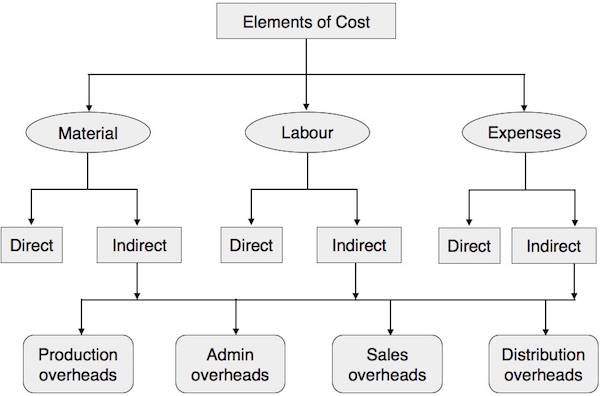
The following chart shows the various elements of cost and how they are classified.
Direct or Indirect Materials
The materials directly contributed to a product and those easily identifiable in the finished product are called direct materials. For example, paper in books, wood in furniture, plastic in water tank, and leather in shoes are direct materials. They are also known as high-value items. Other lower cost items or supporting material used in the production of any finished product are called indirect material. For example, nails in shoes or furniture.
Direct Labor
Any wages paid to workers or a group of workers which may directly co-relate to any specific activity of production, supervision, maintenance, transportation of material, or product, and directly associate in conversion of raw material into finished goods are called direct labor. Wages paid to trainee or apprentices does not comes under category of direct labor as they have no significant value.
Overheads
Indirect expenses are called overheads, which include material and labor. Overheads are classified as:
- Production or manufacturing overheads
- Administrative expenses
- Selling Expenses
- Distribution expenses
- Research and development expenses
A cost sheet is prepared to know the outcome and breakup of costs for a particular accounting period. Columnar form is most popular. Although cost sheets are prepared as per the requirements of the management, the information to be incorporated in a cost sheet should comprise of cost per unit and the total cost for the current period along with the cost per unit and the total cost of preceding period. Data of financial statement is used for preparation of cost sheet. Therefore, reconciliation of cost sheet and financial statement should be done on a regular interval.
Format
|
COST SHEET OR STATEMENT OF COST
Total Units………
|
||
|---|---|---|
| Opening Stock of Raw material | ... ... ... ... | ... ... ... ... |
| Add: Purchases | ... ... ... ... | ... ... ... ... |
| ... ... ... ... | ... ... ... ... | |
| Less: Closing Stock | ... ... ... ... | ... ... ... ... |
| Cost of material Consumed → | ... ... ... ... | ... ... ... ... |
| Add: Direct Labor/Wages | ... ... ... ... | ... ... ... ... |
| Prime Cost → | ... ... ... ... | ... ... ... ... |
| Add: Works overheads | ... ... ... ... | ... ... ... ... |
| Works Cost → | ... ... ... ... | ... ... ... ... |
| Add: Administration overheads | ... ... ... ... | ... ... ... ... |
| Cost of Production → | ... ... ... ... | ... ... ... ... |
| Add: Selling and distribution overheads | ... ... ... ... | ... ... ... ... |
| Total Cost or Cost of Sale → | ... ... ... ... | ... ... ... ... |
Conceptually, accounting is the discipline that provides information on which external and internal users of the information may base decision that result in the allocation of economic resource in society.Accounting provides business-related information to the owner, the management, the employees of the company as well as to the government, creditors, investors, and customers....Slavin and Reynolds
Financial accounting is based on actual past and cost accounting is based on planning and controlling. Preparation of budget is a part of planning and controlling relates to putting a check on the actual function of planning. Comparison of budgeted with actual performance provide the management an idea to eliminate weak performances.
Cost Control Techniques
Costs can be controlling by employing the following methods:- Material Control
- Labor Control
- Overheads Control
- Standard costing
- Budgetary Control
- Capital Expenditure Control
- Productivity and Accounting Ratios
Requirements for Successful Cost Control
The following requirements are to be fulfilled to implement successful cost control:- A plan and a set of well-defined responsibilities to all executives are essential.
- Clear definition of tasks for performance and cost to execute those tasks.
- A fixed responsibility, in case of deviation between targeted and actual.
- Prompt collection of performance data from each department of an organization as the delay in information equals to no information and the management is unable to take correct decision due to lack of complete information.
- Highlights of good and bad, both performances to enable the management to take corrective steps.
- Reward for good performances and Punishment for the poor ones.
Cost reduction is to be understood as the achievement of real and permanent reduction in the unit cost of goods manufactured or services rendered without impairing their suitability for the use intended or diminution in the quality of product.There are only two ways to maximize profit of any organization: either to increase sale price of unit, or to reduce cost of that unit. Both above cases may result into gaining good profit. As we are seeing today, most of the businesses are facing tough competitive market situation where increase in sale price may result in to loss of sale. Increasing sale price is possible only in case of those products where the company is dealing in monopoly items and we all are aware that this situation cannot prolong for any company and its products. Therefore, cost reduction is only one scientific way to deal with this situation; provided it is real and permanent. Cost reduction should not be the result of any temporary decrement in cost of raw material, change in government polices etc. and most importantly, reduction of cost should not be on price of quality of that product.… The institute of Management Accountants, London
Reduction of cost should be in the following manner:
- Volume of production should be same but cost of expenditure should be reduced.
- Without changing level of production there should be increase in production.
Cost Reduction Program
Followings are the essentials of a cost reduction program:- Cost reduction program should be according to requirement of the company.
- Cost reduction program is a continuous activity that cannot be treated as one time or short term activity. Success of any cost reduction program may lie in only continuous improvement of efforts.
- Cost reduction program should be real and permanent.
- Example setter of cost reduction program should be top management employee. Success of this program depends on co-operation of all employees and department of an organization.
- Employees should be rewarded for their participation in cost reduction program and for giving innovative ideas related to this program.
Fields Covered under the Cost Reduction Program
A number of fields come under the scope of cost reduction. They are discussed below.Design
Manufacturing of any product starts with the design of product. At the time of improvement in design of old product as well as at the time of designing new product, some investment is recommended to find a useful design that may reduce the cost of the product in following terms:Material Cost
Design of product should encourage to find out possibility of cheaper raw material as a substitute, maximum production, less quantity etc.
Labor Cost
Design of product may reduce time of operation, cost of after-sale service, minimum tolerance, etc.
Organization
Employees should be encouraged for cost reduction scheme. There should be no scope for doubts and frictions; there should be no communication gap between any department or any level of management; and there must be proper delegation of responsibilities with defined area of functions of an organization.
Factory Layout and Equipment
There should be a proper study about unused utilization of material, manpower and machines, maximum utilization of all above may reduce cost of any product effectively.
Administration
An organization should make efforts to reduce the cost of administrative expenses, as there is ample scope to do so. A company may evaluate and reduce the cost of following expenses, but not the cost of efficiency:
- Telephone expenses
- Travelling expenses
- Salary by reducing staff
- Reduction in cost of stationery
- Postage and Telegrams
Following areas can be covered under the cost reduction program:
- Advertisement
- Warehouse
- Sales Promotion
- Distribution Expenses
- Research & Development Program
- Check the distribution system of an organization about the overall efficiency of the system and how economically that system is working.
- Find out the efficiency of the sales promotion system
- Find out if the costs can reduced from the sales and distribution system of an organization and whether the research and development system of market is sufficient.
- A cost accountant should also do an ABC analysis of customers in which customers may be divided into three categories. For example:
| ABC ANALYSIS OF CUSTOMERS | ||
|---|---|---|
| Category | Number of Dispatches | Volume of Sale Covered |
| Customer...A | About 10% | 60% to 80% |
| Customer...B | About 20% | 20% to 30% |
| Customer...C | About 70% | 5% to 10% |
Financial Management
Attention should be given to the following areas:- If there is any over-investment.
- How much economical is the cost of capital received?
- If the organization is getting maximum returns for the capital employed.
- If there is any over-investment, that should be sold and similarly, unutilized fixed assets should be eliminated. Slow-moving or non-moving inventories should be removed and should transfer this surplus to the working capital to re-invest it in a cycle of more profitable area of business.
Personal Management
Cost reduction programs can be run using staff welfare measures and improving labor relation. Introduction of incentive schemes for labor and giving them better working conditions is very important to run an efficient cost reduction program.Material Control
Cost reduction program should be run by purchasing economical and more useful material. Economic Order Quantity (EOQ) technique should be used. Inventory should be kept low. Proper check on inward material, control over warehouse and proper issuance of material, and effective material yield should be done.Production
Using effective control over material, labor, and machine a better cost reduction program may be run.Tools and Techniques of Cost Reduction
The following tools and techniques are used to reduce costs:- Budgetary Control
- Standard Costing
- Simplification and Variety Reduction
- Planning and Control of Finance
- Cost Benefit Analysis
- Value Analysis
- Contribution Analysis
- Job Evaluation and Merit Rating
- Improvement in Design
- Material Control
- Labor Control
- Overhead Control
- Market Research

Comments
Post a Comment